Volunteering for Success

How Community Involvement Can Help You Stand Out to Employers

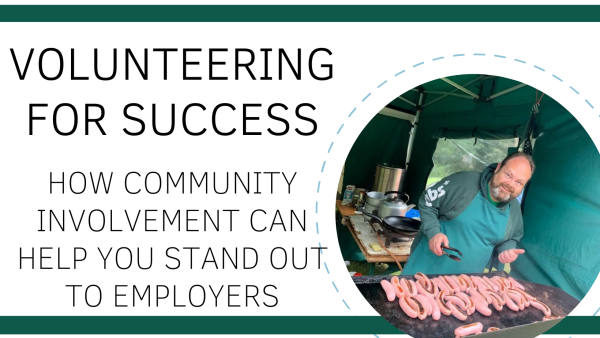
As someone who’s volunteered extensively as a scout leader (that’s me cooking on camp!), I’m here to share with you the benefits of volunteering and how it can make a real difference to your job prospects and career path.

Volunteering offers a wealth of opportunities to develop valuable skills that are highly transferable and can be applied to a wide range of jobs and industries. Whether you work with children, animals, or the environment, volunteering can help you gain skills in leadership, teamwork, and communication that will benefit you throughout your career. (Check out the importance of “soft skills”

But the benefits don’t stop there – volunteering can also help you build a strong professional network. By working alongside other volunteers and professionals in your community, you can make meaningful connections and potentially open doors to new job opportunities. In fact, a survey by Deloitte found that 82% of hiring managers prefer to hire candidates with volunteering experience on their resumes. (Read “The power of networking”)

Now, I know that time is precious, especially when you’re just starting out in your career. But here’s the good news – volunteering doesn’t have to be a huge time commitment. Even just a few hours a month can make a difference and help you gain valuable experience and connections.

As a scout leader, I’ve seen first-hand the benefits that volunteering can bring. Through my involvement in Scouts, I gained skills in organization, leadership, and communication that have helped me in my professional life. And by volunteering in my community, I’ve met other volunteers who are professionals in a variety of industries, which has helped me build my own professional network.

But don’t just take my word for it – research shows that volunteering can have a real impact on your job prospects and career path. In fact, a study by the Corporation for National and Community Service found that volunteers are 27% more likely to find a job after being out of work than non-volunteers.

So, if you’re a school leaver or young professional looking to boost your job prospects and enhance your skills, consider volunteering in your community. It’s a great way to make a difference while also building a strong foundation for your future career. And who knows – you may even discover a new passion or career path along the way!

In conclusion, volunteering can be a valuable asset in your professional life. It can help you gain skills, build your network, and enhance your employability. So, take the leap and start making a difference today – you won’t regret it!

#volunteering #giveback #communityservice #careerdevelopment #jobsearch #networking #employability #skillbuilding #youthdevelopment #makeadifference

The Power of Networking: How to Expand Your Career Opportunities

Why Networking is Key to Career Success and Tips and Strategies for Effective Networking

As a career coach with over a decade of experience, I’ve seen first-hand the importance of networking for career success. It’s not just about who you know, but about building meaningful relationships with others in your industry or field. In fact, research shows that up to 85% of jobs are filled through networking.

Networking therefore is a crucial aspect of building a successful career, but what exactly does it mean? In simple terms, networking refers to the process of making connections and building relationships with people who may be able to offer you professional opportunities, advice, or support. These connections can be made through a variety of channels, such as industry events, social media, or personal referrals. In this post, we’ll explore why networking is important for your career and share some tips on how to get started.

Networking can take many forms, from attending industry events and conferences to reaching out to alumni from your university or college. It’s about making connections and staying top of mind with those who may be able to help you in the future. And with the rise of social media platforms like LinkedIn, it’s easier than ever to connect with professionals in your field.

But effective networking isn’t just about collecting business cards and sending out generic emails. It’s about building relationships and providing value to others. That means being genuine, showing interest in others’ work, and finding ways to help them achieve their goals. It’s about giving as much as you receive.

If you’re new to networking, it can be intimidating at first. But with some practice and the right mindset, anyone can become an effective networker. Some tips and strategies for successful networking include:

  • Setting clear goals for what you want to achieve through networking
  • Being authentic and building genuine relationships with others
  • Following up with contacts and maintaining ongoing communication
  • Giving back by providing value to others and helping them achieve their goals
  • Staying organized and keeping track of your contacts and conversations

Remember, networking is an ongoing process that requires effort and dedication. But by investing in your network, you can expand your career opportunities and achieve greater success in your professional life.

#networking #careersuccess #careeradvice #jobsearch #professionaldevelopment #jobnetworking #jobmarket #jobopportunities #careercoach #careeradviceforstudents

10 Soft Skills Employers Look for in 2023.

Why mastering these skills is crucial for career success in the new job market.

Starting a career can be daunting, especially for young adults who are just about to leave school or have just started their professional journey. As someone who has been a career coach for over a decade, I have seen first-hand how the job market has evolved and how important it is for school leavers and first-time job hunters to be equipped with the right skills to succeed.

As we look to the future, the job market is bound to change in ways that we can’t even begin to imagine. But one thing we know for sure is that soft skills will always be in demand. With the rise of apps like ChatGPT, who knows what jobs we’ll be doing in a few years, but one thing we do know is that mastering these 10 soft skills will give you a leg up in the new job market.

Now, I know what you’re thinking, “But I’m not a softie, I’m a tough, no-nonsense businessperson.” Well think again! According to research, these soft skills are crucial for success in the workplace.

  1. Communication Skills: Sure, you can have all the technical skills in the world, but if you can’t communicate effectively, you’re going nowhere fast. And it’s not just me saying this – a survey by NACE found that 73.4% of employers consider communication skills to be the most important quality in job candidates. You need to be able to articulate your ideas, listen actively, and communicate with people at all levels of the organization.
  2. Critical Thinking: You need to be able to analyse information, make decisions, and evaluate outcomes. And guess what? According to the World Economic Forum’s Future of Jobs report, critical thinking and problem-solving are among the top 10 skills needed for the future workforce. So, if you want to be a valuable asset to any company, sharpen those critical thinking skills!
  3. Adaptability: In today’s fast-paced job market, being able to adapt to new challenges and changing circumstances is essential. And you don’t have to take my word for it – a report by McKinsey Global Institute predicts that up to 375 million workers worldwide may need to switch occupational categories and learn new skills by 2030. So, it’s time to be flexible and adaptable, folks!
  4. Teamwork: You need to be able to collaborate and communicate effectively with others, and contribute to achieving shared goals. According to a LinkedIn survey, 80% of professionals believe that networking and building relationships are important to career success.
  5. Time management is also crucial. You need to be able to prioritize tasks, meet deadlines, and manage your workload efficiently. And if you’re constantly late, beware! According to a survey by CareerBuilder, 29% of employers say that tardiness is the top productivity killer in the workplace.
  6. Leadership: Even if you’re not in a management position, leadership skills are important. According to a study by Deloitte, leadership is the most important talent issue facing organizations today. Employers value candidates who can take initiative, motivate others, and drive change.
  7. Digital Literacy: Technology is a crucial part of most jobs today. According to a report by Burning Glass Technologies, there is a digital skills gap in the workforce, with more jobs requiring digital skills than workers who possess them. You need to be proficient in using basic software and tools and be able to learn and adapt to new technologies.
  8. Emotional Intelligence: Emotional intelligence involves being aware of and managing your own emotions, as well as understanding and empathizing with others. According to a study by TalentSmart, emotional intelligence is responsible for 58% of a leader’s job performance. Employers value candidates who can work well with others, manage conflicts, and maintain positive relationships.
  9. Creativity is the top-rated skill sought by employers, according to a report by the Conference Board. You need to be able to come up with new and innovative ideas, and think outside the box. Employers value candidates who can bring fresh perspectives and contribute to creative problem-solving.
  10. Professionalism: Professionalism involves demonstrating the appropriate behaviour, attitude, and appearance in the workplace. According to a survey by Accountemps, 93% of executives say that a person’s attire at work influences his or her chances of promotion. You need to be punctual, reliable, and respectful of others.

In conclusion, starting your career can be challenging, but by developing these essential skills, you can increase your chances of success in the workplace. Remember the wise words of Albert Einstein, The measure of intelligence is the ability to change”, so continue to learn and develop these skills throughout your career.

#softskills #careersuccess #jobmarket #communication #criticalthinking #adaptability #teamwork #timemanagement #leadership #digitalliteracy #emotionalintelligence #creativity #professionalism

Nail Your Job Interview: The 5 Tips That Make a Difference

Insights from a Career Coach and a Serial Interviewee

Are you getting sweaty palms just thinking about your next job interview? Don’t worry, you’re not alone. Even seasoned professionals can get nervous and make mistakes when facing a hiring manager. But there are ways to boost your chances of acing the interview and landing the job you want. As a career coach with years of experience, I’ve seen what works and what doesn’t in the interview room. But I’ve also been on the other side of the table more times than I care to admit. So, let me share with you the 5 tips that I believe can make a significant difference in your interview performance.

  1. Research the company and the role Don’t go into an interview blind. Do your homework and learn as much as you can about the company’s history, culture, products, and services. Also, review the job description and make a list of the skills and qualifications that the employer is looking for. Then, prepare examples of how your experience and achievements match those requirements. According to a survey conducted by Harris Poll, 50% of hiring managers claimed that candidates who are well-prepared for an interview are more likely to receive a job offer.
  2. Practice your answers While you can’t predict all the questions that you’ll be asked, you can prepare some standard responses to common ones, such as “Tell me about yourself,” “Why do you want to work here?” and “What are your strengths and weaknesses?” Practice these answers out loud, with a friend or a mirror, and try to be concise, relevant, and confident.
  3. Dress for success You don’t need to wear a three-piece suit to every interview, but you do need to look professional and polished. Choose clothes that fit well, are clean and pressed, and match the industry and the company’s dress code. Avoid flashy accessories or strong perfumes/colognes, as they can distract or irritate the interviewer. In a survey conducted by CareerBuilder, 78% of hiring managers said that a candidate’s attitude can impact their hiring decision.
  4. Ask smart questions An interview is not just a chance for the employer to evaluate you, but also for you to evaluate the employer and the job. Use this opportunity to ask questions that show your interest, curiosity, and strategic thinking. For example, “What are the biggest challenges that this department is facing?” “What is the career path for this role?” “How does this company foster diversity and inclusion?” According to a survey conducted by Glassdoor, 84% of interviewees who ask insightful questions during an interview are more likely to be offered the job.
  5. Follow up with gratitude After the interview, don’t just wait for the phone to ring. Take the initiative to send a thank-you note or email to the interviewer, expressing your appreciation for their time and reiterating your interest in the job. This gesture not only shows your politeness and professionalism but also reminds the employer of your strengths and enthusiasm. A study by CareerBuilder found that 22% of hiring managers are less likely to hire a candidate who doesn’t follow up after an interview.

Of course, these tips are not fool proof, and every interview is different. But by applying them, you can increase your chances of making a positive impression, building rapport with the interviewer, and standing out from the competition. And remember, even if the interview doesn’t lead to a job offer, it can still be a valuable learning experience that helps you grow and improve. So, keep practicing, keep smiling, and keep the faith. Good luck!

Hashtags: #jobinterviewtips #interviewsuccess #careercoach #interviewhacks #jobsearch #interviewprep #gethired #interviewstrategies #interviewconfidence #interviewmistakes

10 In-Demand Careers for future School Leavers

Are you a school leaver wondering what career path to pursue? Or a parent looking to guide your child towards a stable and rewarding profession? With technological advancements and global shifts in industry, it can be tough to predict which jobs will be in demand in the future. However, based on reports from industry experts, here are 10 careers that are projected to be in high demand in the next 10 years:

  1. Artificial Intelligence and Machine Learning Specialists
  2. Data Analysts and Scientists
  3. Cybersecurity Experts
  4. Renewable Energy Technicians
  5. Virtual Reality Designers and Developers
  6. Healthcare Professionals
  7. Robotics Engineers
  8. Sustainable Agriculture Specialists
  9. Creative Professionals
  10. Environmental Scientists and Specialists

To succeed in these careers, it’s important to have the right skills and knowledge. For example, those pursuing a career in AI and machine learning will benefit from programming languages such as Python, R, and Java, as well as statistical analysis and modeling skills. Similarly, cybersecurity experts will need to have knowledge of networking and system administration, security protocols, and threat analysis.

Sustainable agriculture specialists, on the other hand, will need to have knowledge of sustainable farming practices and conservation, soil science, and pest and disease management. And creative professionals will need skills in graphic design, digital media production, writing, and social media management.

As you can see, each career requires a unique set of skills and knowledge. It’s important to keep in mind that the job market is always evolving, and new skills and technologies may become essential in the future. As digital transformation strategist Sukant Ratnakar says, “Our future success is directly proportional to our ability to understand, adopt and integrate new technology into our work.” Therefore, continuous learning and adaptation is key to staying relevant and successful in these careers.

In conclusion, there are a range of career paths available for school leavers and it’s important to choose a profession that aligns with your interests and passions. By focusing on the skills and knowledge required for these 10 in-demand jobs, you can future-proof your career and stay ahead of the curve. As Alan Kay, computer scientist and inventor, says, “The best way to predict the future is to invent it.” So why not start inventing your own successful future today?

This post is based on data from the following reports:

  • “The Future of Jobs Report 2020” by the World Economic Forum
  • “The Future of Skills Report” by the Institute for the Future (IFTF)
  • “The Future of Work: Jobs and Skills in 2030” by Pearson and Nesta

#FutureCareerGoals #SkillsForSuccess #TheNextDecade #CareerAdvice #InDemandJobs #BeyondTheClassroom #PrepareForTheFuture #ThrivingInTech #CareerPathfinder #NavigateYourFuture

5 Mistakes to Avoid When Writing Your CV or Resume

Are you a recent school leaver who is crafting a CV or resume for the first time? Or are you a parent helping your child create a CV or resume? Either way, it’s important to know what to include – and what to leave out. Your CV or resume is a crucial document that can make or break your chances of getting an interview. To help you avoid some common mistakes, here are five things you should NOT put in your CV or resume:

  • Personal details: Avoid including personal details such as your age, marital status, or religion. These details are irrelevant to your ability to do the job and can even be discriminatory. As a career coach, I always advise my clients to keep their personal information private and only include information that is relevant to their job application.
  • Unprofessional email addresses: Your email address is one of the first things a hiring manager sees when reviewing your CV or resume. It’s important to use a professional email address that includes your name or initials. Avoid using email addresses that are unprofessional, such as “partygirl123” or “skaterdude”. According to a survey by CareerBuilder, “70% of hiring managers believe that an unprofessional email address or social media profile can negatively impact a candidate’s chances of being hired.
  • Irrelevant work experience: When creating your CV or resume, it’s important to focus on relevant work experience. Avoid listing jobs that are not related to the position you are applying for. I always advise my clients to tailor their resume to the job description and highlight their relevant experience.
  • Personal pronouns: Your CV or resume should be written in a professional tone. Avoid using personal pronouns such as “I”, “me”, or “my”. Instead, focus on using action verbs and phrases that demonstrate your skills and achievements. For example, instead of saying “I managed a team of five employees”, say “Managed a team of five employees”.
  • Negative language: Your CV or resume should showcase your skills and achievements in a positive light. Avoid using negative language or focusing on your weaknesses. Instead, focus on your strengths and accomplishments. As a blogging expert, I always encourage my clients to highlight their achievements and focus on what they can bring to the table.

In conclusion, your CV or resume is a crucial document that can impact your chances of getting an interview. By avoiding these five common mistakes, you can create a strong and professional CV or resume that highlights your skills and experience. Remember, your CV or resume is your first impression – make it count!

#SchoolLeavers #CareerAdvice #JobSearch #InterviewTips #Volunteering #Networking #LinkedInTips #UniversityvsWorkforce #CareerPaths

Future In-Demand “Non-TECK” Career Paths for School Leavers

If you’re a school leaver who isn’t interested in pursuing a career in technology, you may be wondering what other job opportunities are available. While the tech industry may be booming, there are still plenty of other career paths that are in high demand and offer a promising future. Here are 10 job titles and career choices that are predicted to be in-demand over the next decade:

  1. Healthcare professional
  2. Teacher or education professional
  3. Environmental scientist or specialist
  4. Marketing and advertising professional
  5. Financial advisor or analyst
  6. Social worker or human services professional
  7. Cybersecurity professional
  8. Creative professional (e.g. graphic designer, writer, artist)
  9. Legal professional
  10. Sales professional

According to the World Economic Forum’s “Future of Jobs Report 2020,” the healthcare industry is projected to experience significant growth in the coming years due to an aging population and increased demand for healthcare services. In addition, teachers and education professionals will continue to be in high demand as the education system adapts to changes in technology and curriculum. Environmental scientists and specialists will be needed to address climate change and sustainability issues, while marketing and advertising professionals will be essential for businesses looking to stay competitive in a rapidly evolving marketplace.

Future In-Demand “Non-TECK” Career Paths for School Leavers

The Institute for the Future’s “Future of Skills Report” highlights the importance of social and emotional intelligence, complex problem-solving, and critical thinking skills for success in the workforce. Financial advisors and analysts will need strong analytical and problem-solving skills to help clients make informed financial decisions, while social workers and human services professionals will require strong interpersonal skills to support vulnerable individuals and communities. Cybersecurity professionals will be needed to protect businesses and individuals from online threats, and creative professionals will be important for companies looking to innovate and differentiate themselves from competitors. Legal professionals and sales professionals will also continue to be in demand across a range of industries.

It’s important to note that while these careers may not be tech-based, many of them will still require some level of technology skills and familiarity with digital tools. For example, healthcare professionals may need to be proficient in electronic health records systems, while marketing professionals will need to be familiar with social media platforms and digital advertising tools.

As you consider your future career path, think about your own strengths and interests, as well as the skills and education required for the careers that interest you. Pursuing a career that aligns with your passions and values is key to finding long-term success and satisfaction.

In conclusion, while the tech industry may be dominating headlines, there are still plenty of other in-demand career paths available to school leavers. By staying informed about the trends and job opportunities in different industries, you can chart a course for a successful and fulfilling career.

This post is based on data from the following reports:

The Future of Jobs Report 2020″ by the World Economic Forum

The Future of Skills Report” by the Institute for the Future (IFTF)

The Future of Work: Jobs and Skills in 2030″ by Pearson and Nesta.

#careersuccess #careerdevelopment #jobopportunities #futureofwork #independentfuture #newgradjobs #careeradvice #skillbuilding #careerplanning #beyondtech

Website Powered by WordPress.com.

Up ↑